Peliou New Materials Technology Co.,LTD
Discover how 2500×3000mm ground protection mats deliver 150–200 ton load capacity, fast coverage, and reliable performance on construction sites, oil fields, and event grounds.
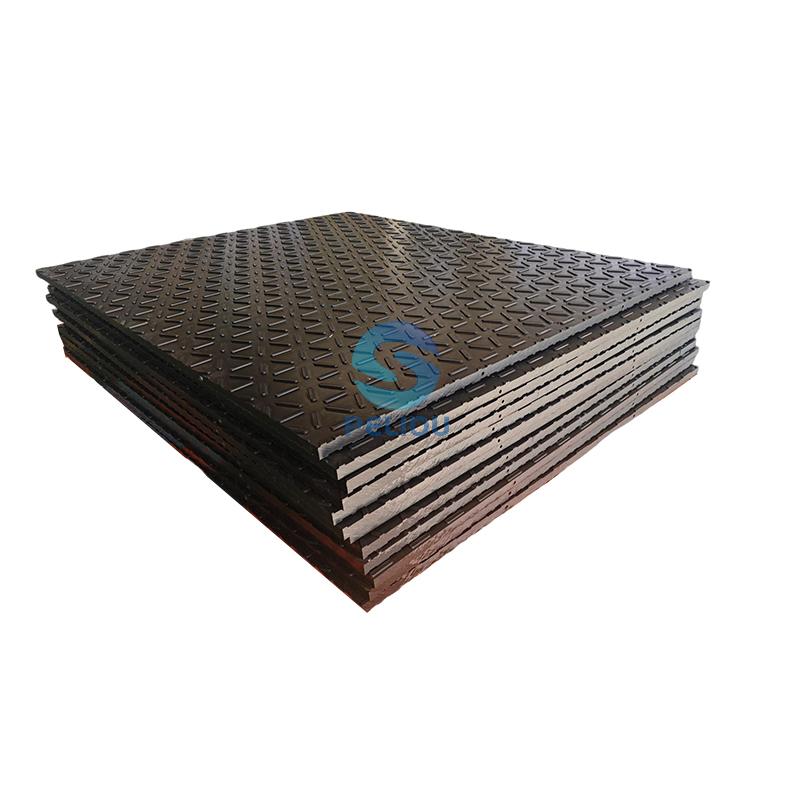
When site conditions turn soft, uneven, or environmentally sensitive, the size of your ground protection mat directly affects how fast you can build a safe working surface—and how much load that surface can carry. Among the standard heavy-duty formats, the 2500 × 3000 mm ground protection mat has become a preferred choice for contractors, event organizers, and industrial operators who need large coverage per panel without sacrificing load-bearing strength.
This article explains the load capacity of 2500×3000mm mats, the scenarios where this size outperforms smaller alternatives, and why it deserves a place in your temporary access planning.
The load-bearing capacity of a 2500×3000mm ground protection mat depends primarily on its thickness, material formulation, and the ground conditions beneath it. Across the industry, heavy-duty panels in this footprint are rated in the 150–200 ton range under proper installation.
A 38mm-thick HDPE or UHMWPE mat at 2500×3000mm typically supports up to 200 tons as a trackway or work pad, with a panel weight around 293–295 kg—light enough for efficient handling with standard lifting equipment, yet strong enough for the heaviest plant machinery. Other configurations in the same size deliver 150–160 ton capacity, which remains more than sufficient for excavators, drilling rigs, concrete pumps, and loaded HGV traffic.
It is important to note that published load ratings assume correct installation and normal ground conditions. On very soft or saturated ground, the effective capacity may be governed by the subgrade rather than the mat itself, so ground assessment remains part of responsible specification.
Not every project needs the largest mat available—but when time, safety, and surface continuity are priorities, the 2500×3000mm format offers practical advantages that smaller panels cannot match.
Each 2500×3000mm mat provides 7.5 square meters of coverage. That means fewer panels to transport, fewer connections to align, and faster completion of temporary roads, crane pads, and staging areas. On sites where downtime is measured in hours, this reduction in manual handling directly translates into schedule savings.
Every joint between mats is a potential weak point. By covering more ground per panel, the 2500×3000mm format reduces the total number of connections required. Combined with interlocking connector systems at each corner, the result is a more continuous, stable working platform for heavy equipment and pedestrian traffic alike.
Many 2500×3000mm heavy-duty mats feature a dual-profile design—an aggressive chevron or cleated surface on one side for vehicle traction, and a lower-profile reverse side for safe pedestrian movement. This makes a single mat suitable for both plant routes and walkways, simplifying site logistics.
The combination of large coverage and high load capacity makes this size particularly well suited to the following applications:
Construction site access roads and haul routes: Create stable temporary roadways over mud, clay, or unprotected finished surfaces, protecting the subgrade while keeping delivery vehicles and excavators moving.
Crane pads and heavy equipment work platforms: Provide a firm, load-distributing base for mobile cranes, piling rigs, and concrete pumps operating on soft or uneven ground.
Oil, gas, and pipeline projects: Establish durable working platforms and access routes in remote or difficult terrain where conventional road construction is impractical.
Event and sports ground protection: Cover large areas of grass or sensitive landscaping for festivals, outdoor exhibitions, and temporary pedestrian routes, then remove the mats with minimal turf damage.
Environmental and wetland projects: Reduce soil disturbance and rutting in ecologically sensitive areas, particularly where non-conductive and chemically inert materials are required.
Military and emergency access: Deploy quickly across car parks, compounds, and unstable surfaces where reliable heavy-vehicle access must be established at short notice.
Within the 2500×3000mm footprint, thickness determines the balance between weight, handling, and maximum load rating. As a general guide:
25 mm panels suit medium-duty access and lighter vehicle traffic, with load ratings typically around 120–180 tons depending on construction.
38 mm panels represent the heavy-duty standard, delivering 150–200 ton capacity and the durability required for continuous plant traffic and repeated deployment.
Specifying the correct thickness for the heaviest equipment expected on site—while accounting for ground conditions—is the most reliable way to avoid overloading and extend mat service life.
The 2500×3000mm ground protection mat is more than a larger panel—it is a productivity tool for sites where load capacity, surface continuity, and installation speed all matter. With ratings reaching 200 tons in heavy-duty configurations and 7.5 m² of coverage per mat, it reduces joint count, accelerates deployment, and delivers a stable platform across construction, energy, events, and environmental projects.
If your next project involves heavy equipment on soft ground—or simply demands a faster, more reliable temporary surface—the 2500×3000mm format deserves serious consideration.
Explore our heavy-duty ground protection mat range or contact our team to confirm the right thickness and connector system for your site conditions.
Previous: Back List Next: UHMWPE Rod Manufacturer Selection Guide: Applications & Key Sourcing Criteria
ODM & OEM
UHMWPE, HDPE, PP, Nylon, ABS and any Material
Customized Packaging
Graphic customization
Size & Color custom
